Showing posts with label philosophy. Show all posts

10.13.2014

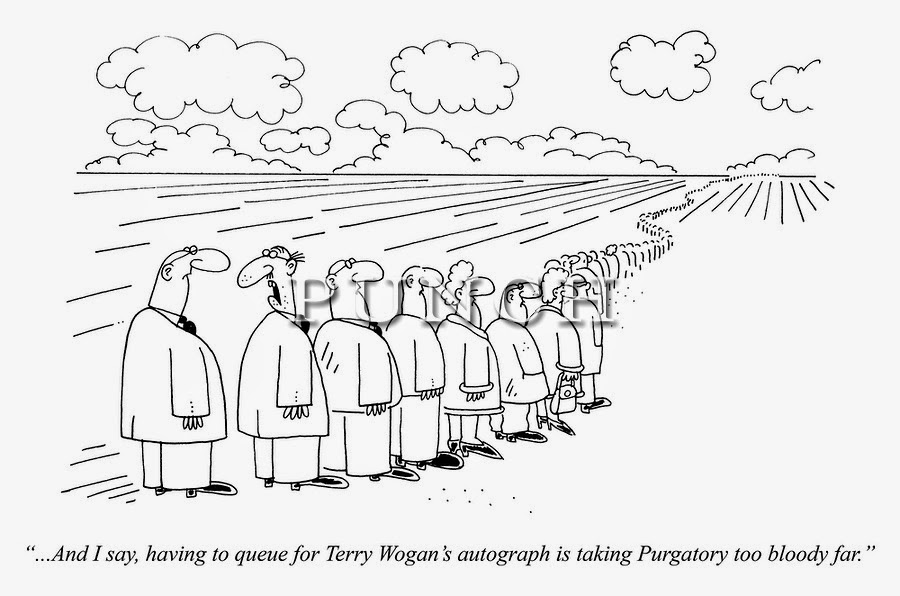
What About Purgatory?

I never, even for a moment, entertained the notion that the doctrine of Purgatory may be true for the first 30+ years of my life. The only thought I ever gave to the doctrine was for about 20 minutes in high school when a Catholic girl spoke about the doctrine at Youth Alive. It was an awful experience for everyone involved. It was awful for her because she really didn't have a strong enough grasp on the doctrine to speak about it, much less defend it, in front of a hostile and more-or-less biblically knowledgeable crowd. It was awful for the rest of us because a few of us who had less than zero tact went on the offensive and ended up making her cry. I didn't feel so bad about it at the time, but in retrospect it was an instance severely lacking in Christlikeness.

Now that I've come to terms with the fact that doctrinally I'm more traditionally orthodox than I previously suspected, I've decided it's probably time to start thinking more seriously about Purgatory. This post will be a bit of an outline of why I'm considering giving this doctrine an endorsement. I'm not ready to commit just yet, don't get me wrong. I think, though, that if I were really forced to hazard a guess, my guess would be in the affirmative.

I think the primary source of my skepticism of Purgatory has been an almost complete lack of understanding of some basics about the doctrine. Before moving on to my argument, then, I want to make two points.

First, it is often claimed that Purgatory is a figment of the Catholic Church's imagination, designed primarily for the purpose of collecting indulgences (in fact, when I mentioned Purgatory to my roommates, the first thing one of them said was, "didn't the Catholic Church just make that up?").  In reality, though, it's not clear that this doctrine was ever in doubt at any point prior to the Reformation. References to the doctrine go all the way back to the second century C.E. (Origen, Hippolytus) and it appears from Augustine and Gregory I to have been widespread by the fourth and fifth centuries.  Further, a fairly rich tradition of belief in a Purgatorial state exists in ancient Jewish literature (Talmud and Apocrypha for sure, and possibly Josephus), which lends credence to the idea that early Christians received the belief as part of the Jewish tradition from which Christianity arose.

Next, I think the basic definition of the doctrine needs to be established, since it is commonly misunderstood by outsiders to Catholicism/Orthodoxy.

The Catechism of the Catholic Church defines the doctrine in this way:

1030 "All who die in God's grace and friendship, but still imperfectly purified, are indeed assured of their eternal salvation; but after death they undergo purification, so as to achieve the holiness necessary to enter the joy of heaven.

1031 “The Church gives the name Purgatory to this final purification of the elect, which is entirely different from the punishment of the damned."

St. Gregory is then quoted as giving the following argument:

"As for certain lesser faults, we must believe that, before the Final Judgment, there is a purifying fire. He who is truth says that whoever utters blasphemy against the Holy Spirit will be pardoned neither in this age nor in the age to come. From this sentence we understand that certain offenses can be forgiven in this age, but certain others in the age to come."

The supposed efficacy of prayers for the dead is also listed as justification for the doctrine, but since I am skeptical of said efficacy, I won't bother quoting this section.

Purgatory is not, as is the common misconception, a place where souls who narrowly missed the cut will go to earn the rest of their salvation by suffering for their sins. It is a place where those who are already saved will go for purification.

I'm not going to spend a bunch of space here defending the doctrine against all comers. If objections come later (and I hope they do), I'll try to deal with them then. For now I want to try to reason through why I believe Purgatory may be exactly the kind of place we would expect an omni-benevolent God to create.  

In the argument that follows, I assume the following controversial beliefs to be true and will not offer independent arguments for them here: Christian orthodoxy, some sort of mind/body dualism, inclusivism, progressive sanctification, and theosis.  I'm sure I've missed some, but these are the ones that come to mind for now.

I think that if God is omni-benevolent, He would provide a possibility for the salvation of the unchurched. Otherwise, He creates certain people (a great many people, in fact) without any possibility of avoiding damnation, then holds them accountable for it. I doubt this can be reconciled with a loving creator. The great theologian Karl Rahner spoke of “anonymous Christians.” This term refers to non-Christians who are saved by the grace of Christ. The view that anonymous Christians exist is called “inclusivism.” Again, I have no intention of defending inclusivism here. Suffice it to say that for the purposes of this argument I'm assuming the truth of inclusivism. This is to say that I believe many who have never heard the gospel, have only heard a distorted version of it, lack the mental capacity to grasp it, etc. may nevertheless be saved by God's grace. This is a pretty widespread intuition in many, if not most, Christians I know.

So under the assumption that anonymous Christians exist, here is my argument.

As a first premise, we'll simply state what we know about anonymous Christians: they will have had no opportunity to undergo any real process of sanctification in their earthly life. After all, how can one undergo a process of becoming more Christlike or of conforming her will to Christ's if she has never heard of Christ or been introduced to His teachings? So my first premise is just that anonymous Christians will end this earthly life without having undergone sanctification.

Second premise: some degree of sanctification is required to be in communion with God (I know “communion with God” is a loaded term. When I use this term I'm thinking about remaining in the presence of God post-judgment). This belief is firmly entrenched in the history of Christian thought, and is a part of any version of the ordo salutis. I won't do any exegesis, so if anyone wants to dispute this interpretation of the verses that follow they are welcome to do so. Here's a little rundown of texts I think support this claim: Lev. 11:44, Rom. 6:22, 2 Cor. 3:18, 1 Thess. 5:23, Heb. 12:14, and Rev. 3:15-20. Interestingly, Rev. 3:15-20 was the text used in the incident I referenced above to make the poor Catholic girl cry. I thought for sure it created an air-tight case against Purgatory. Now I think actually creates a case for this premise. If God spews the luke-warm out of his mouth, does this not demonstrate that one must have undergone some degree of sanctification in order to be in communion with Him?

So the argument thus far is this:

1.  Anonymous Christians will end this earthly life without having undergone sanctification.
2.  Sanctification is required to be in communion with God.

Now let's add one more:

3.  Anonymous Christians will eventually be in communion with God. I take this to be obvious. The definition of an “anonymous Christian” is just someone who is not a “Christian” by creed, but who is, in fact, saved. If one is saved, she will eventually be in communion with God.

So:

4.  Anonymous Christians will end this life without having undergone that which is  required to be in communion with God. (1,2)

5.  Those who will eventually be in communion with God will end this life without having undergone that which is required to be in communion with God. (3,4)

The conclusion must be that that which is required for communion with God (sanctification) will happen at some point other than this earthly life. Continued sanctification, especially in the Eastern Orthodox tradition, is the primary purpose of Purgatory. It also meets the qualification of not being part of this earthly life. I think, then, that if one shares my intuitions about anonymous Christians/inclusivism and the benevolence of God, she should very seriously consider the doctrine of Purgatory to be a live option in her theology.

Though my argument above is specific to inclusivists like me, please don't make the mistake of thinking Purgatory is only an option for inclusivists.  It isn't.  The example that comes to mind is the thief on the cross with Jesus.  Surely the thief will have no time to undergo sanctification prior to his death.  Should we say he will never undergo sanctification and will thereby skip an important step in the ordo?  Perhaps purgation is a simple theological solution even for exclusivists who want to retain strong notions of the necessity of sanctification for communion with God.

11.23.2013

Songs For Thinkers

A number of years ago I posted about a list of the top conservative rock songs of all time and gave some suggestions for new ones that should be on the list.

I recently found a new list over at Faith & Theology that was quite entertaining (if disappointing in spots).  The list was an effort to pick a rock song to represent the thought of 40 philosophers.  Here's a link to the list.  These were my 10 favorites - the ones I think the list gets most right:

Plato - "Cave" by Muse
Epicurus - "Let's Live for Today" by The Grass Roots
Augustine - "Time and Love" by Laura Nyro
Rene Descartes - "Suspicious Minds" by Elvis Presley
Thomas Hobbes - "Welcome to the Jungle" by Guns N' Roses
Gottfried Leibniz - "Wonderful World" by Sam Cooke
George Berkeley - "It's All in My Mind" by George Jones
Ludwig Wittgenstein - "Vienna" by Ultravox
John Rawls - "Long Black Veil" by The Band
Harry Frankfurt - "Rock N' Roll Bullshit" by Against Me

It's hard to find pictures related to this post, so here's a funny comic instead!

Now, I'll admit that some of the others I probably don't get because I'm not familiar with everyone's work.  And some are probably connected by lyrics in the song that I'm unfamiliar with.  But some are just blatantly wrong.  He gave Karl Marx the song "Money" by Pink Floyd.  Preposterous.  Yes, the song talks about a few of the negatives of money, but mostly just talks about what money gets you and its role in modern life...which, of course, Marx hated.  I would have thought "Money" would be a perfect song for someone like Weber, Hayek, or Friedman.  Another horrible selection was "Uncle John's Band" for John Locke.  Seriously?  You just picked that because it has the name "John" in it.  So this is apparently the theme song for everyone in the world named John.  Such a lazy pick.

This list claims to be "rock songs" but a quick glance through makes it pretty clear that "rock" is being defined quite liberally here.  George Jones?  Since when is George Jones "rock"?  Bob Dylan, Ray Charles, the Bee Gees...these are all pretty questionable for the title "rock".  So instead of limiting my list to "rock" I'll limit it to songs in my library.  Here are some I came up with.  Some are new for philosophers not on the list and some are different options for guys that are on there already.  There are a few who aren't technically "philosophers" but they are at least closely related to philosophy and the songs fit, so I included them anyway.

...And another (from xkcd.com)

Parmenides - "One" by Metallica
Karl Marx - "Imagine" by John Lennon
Ayn Rand - "The Trees" by Rush
Ludwig Wittgenstein - "Vicious Circles" by Aaron Lewis
Peter Singer - "Dirty Deeds" by AC/DC
William James - "Because I Got High" by Afroman
Maimonides - "Pretty Fly for a Rabbi" by Weird Al Yankovic
Jacques Derrida - "Ramblin' Man" by The Allman Brothers
Clark Pinnock - "Flavor of the Week" by American Hi-Fi
Sun Tzu - "Art of War" by Anberlin
David Lewis - "If I Could Turn Back Time" by Cher
John Locke - "Fight for Your Right" by The Beastie Boys
Richard Dawkins - "Loser" by Beck
Thomas More - "Shangri-La" by Believable Picnic
Aristotle - "Heaven is a Place on Earth" by Belinda Carlisle
Gaunilo - "Antisaint" by Chevelle
David Chalmers - "Zombie" by The Cranberries
Bill Joy - "Armageddon It" by Def Leppard
Bertrand Russell - "White Flag" by Dido
Montesquieu - "Dear X (You Don't Own Me)" by Disciple
Voltaire - "Ordinary World" by Duran Duran
Plato - "My Immortal" by Evanescence
John Duns Scotus - "Everybody's Fool" by Evanescence
William of Ockham - "Razor" by The Foo Fighters
J.L. Schellenberg - "Unanswered Prayers" by Garth Brooks
Cornel West - "Damn it Feels Good to be a Gangsta" by Geto Boys
Thales - "Liquid" by Jars of Clay
Thomas Kuhn - "Jump" by Kris Kross
Edmund Gettier - "Don't Know Much" by Linda Ronstadt & Aaron Neville
Gorgias - "I Alone" by Live
Nelson Pike - "Fatalist" by Monarch
Blaise Pascal - "The Gambler" by Kenny Rogers
Friedrich Nietzsche - "Everybody Wants to Rule the World" by Tears for Fears
Peter van Inwagen - "Freewill" by Rush
Emmanuel Levinas - "Epiphany" by Staind

Hope you enjoyed!

3.24.2013

On Retroactive Impetratory Prayer

As I was driving today I began thinking again on a theological topic that has crossed my mind before, but that I've never actually put to much proper consideration.  When it comes to the problem of divine foreknowledge, I'm generally in the Molinist camp.  For those of you not familiar with what Molinism is, I recommend that you follow that little blue link prior to reading below.  Or you can just read on and try your best.  Or you can (as I suspect most people will choose to do) just stop reading.

Ok, so here is the question: If today I choose to pray that event E that happened yesterday would not have happened, (a) is it possible that God answer this prayer and (b) is it plausible that God would answer this prayer.  I'm calling this "Retroactive Impetratory Prayer" (hereafter, RIP).

I've come to the conclusion that (a) depends on which theological view to you hold to with regard to divine providence.  Let's start there.

Suppose I am an Open Theist approaching this question.  The Open Theist almost certainly has to answer in the negative.  On Open Theism, God does not have complete, definite foreknowledge.  He can be 99.999% certain of most things and even 100% certain of some things, but most things are probably in the "extremely well-informed guess" category rather than the "absolute certainty" category.  If this is the case, then there is no way that God could really justify answering a prayer that He doesn't know with absolute certainty will be prayed.  There's no way, then, that He actually would answer a prayer prior to its being prayed since it's still possible that the prayer won't be prayed.  This could change once all the necessary and sufficient conditions are met for a given prayer's being prayed.  Once that happens, I would think that answering the prayer prior to its instantiation would be fair game for God on Open Theism as well.

The Augustinian/Calvinist (A/C) (determinism or compatibilism, take your pick) view would also have to answer in the negative.  Strictly speaking, the past happened the way it did because God intentionally caused it to be that way in every case.  For God to answer a prayer prior to its being prayed, God would have to essentially admit that His plan was flawed to start with and then change it.  Of course, some of you A/C folks out there may disagree with my interpretation here, and if so I'd appreciate hearing about it.  One reason you may want to disagree is that this exact same reasoning can be used against the possibility of impetratory prayer of any kind on the A/C view, which is something I bet a lot of folks will want to avoid.  And, incidentally, this is yet another great reason not to hold the A/C view.  Just sayin'.

The Molinist, it seems to me, is the only one who can really entertain the possibility of RIP being able to work on any consistent basis.  First, on Molinism prayer definitely has the potential to impetrate.  That is, God's decisions in the world are definitely affected by prayer.  Second, God knows prior to the creation of the world exactly what prayers will be prayed at what time and by whom.  Third, it seems to me to be possible, if not probable, that God would be willing to take those future prayers into account when guiding events prior to the prayer.  So I think that the RIP issue is one that Molinists are (mostly) unique in having to address.  So there is my answer to (a).  (Brief aside: I'm not really sure if it's possible that a Molinist hold to a B-theory of time.  Haven't thought about it too much.  If one were to do so,  there may be some issues there as well...which I haven't bothered considering.  For now, though, I'm going to assume an A-theory of time and move on.) 

Now, if a Molinist answers affirmatively to (a), then what of (b)?  Well, I think first we need to recognize that on the Molinist account of prayer, God makes the decision of whether or not to answer a prayer prior to the creation of the world, so strictly speaking the time at which a prayer is prayed shouldn't affect His ability or willingness to answer it.  The problems really come when we conceptualize the prayer.  Say E happened yesterday and it displeased me.  Now let's say that I choose today to pray that E never happened.  Well, if I know I pray the prayer in the first place I already know that it went unanswered.  If there is but one timeline (and I think it's pretty reasonable to think this is the case, especially on the Christian worldview), it follows that events I have already experienced cannot be changed.  Those events would have never have been able to take place were my prayer answered retroactively (i.e. prior to my prayer having been prayed).  So, then, if I believe in the possibility of RIP, it follows that if I attempt a retroactive prayer I'm already guaranteed that the prayer was not answered.

But this is not the end of the issue!  Far from it.  No, no.  This is right where it gets interesting.  See, the mere fact that my praying for retroactive answers guarantees that those retroactive answers didn't happen does not mean that such prayers are completely superfluous!  God may actually answer some retroactive prayers, it's just that the believer who would have done the praying would never know it.  However, in order for there to be the possibility of such a prayer being prayed, the believer must actually get in the habit of praying such prayers.  Example:

Suppose there are two separate and unrelated events E1 & E2.  Believer B dislikes both and will pray that both did not happen in the past (these prayers will be P1 & P2, respectively).  God decides logically prior to creation whether or not he will answer either prayer.  Say God decides to answer P2 but not P1, so that E2 would not have happened, but E1 still would.  B would still have to have a mindset that may cause her to pray both P1 & P2 in order for P2 to be answered.  Likely, then, prayers of the P1 variety would still have to be prayed (even though B knows the prayers are superfluous) in order to guarantee that prayers of the P2 variety would also have been prayed (and thus not have taken place).  Otherwise there is no possibility that God know via middle knowledge that P2 would be prayed (since it would not, in fact, be prayed), and thus He would not prevent E2 from obtaining.

So the answer to (b) above would be: no. It is impossible that God answer the retroactive request you are currently praying for.  However, the Molinist can (and maybe even should) believe that such prayers may nevertheless be necessary in order for God to answer other retroactive prayers that she will never actually pray.

I really look forward to some thoughts on this from any of you theology dabblers out there!

**Update**

In a discussion I had on this last night with my roommate, I found that framing the issue in more explicitly Molinist terms was helpful.

Molinism, roughly, is the belief that God obtains His foreknowledge from the combination of three logical moments.  Moment 1: natural knowledge (knowledge of all necessary truths).  Moment 2: middle knowledge (knowledge of the truth value of all counterfactuals).  Next comes the decision to create the world.  Knowledge from moments 1 and 2 are then combined with the knowledge of which world was created, which gives God moment 3: Free knowledge (complete, definite foreknowledge of all circumstances that will obtain in the world and all free choices that will be made by creatures in those circumstances).

Consider the example I gave above in Molinist terms:

Prior to creation, God is presented with 2 counterfactuals:

C1. Given E1, B would freely choose P1.
C2. Given E2, B would freely choose P2.

Assuming both counterfactuals are true, God then weighs whether or not He plans to answer either P1 or P2 (or both) and chooses (still prior to creation) to answer P2, but not P1.

E2 now will never obtain.  B will only ever pray P1 and B will have no idea that E2 (and thus P2) was ever even a possibility.  B will certainly have no idea that God answered P2 without it ever happening.

However, the truth value of counterfactuals is determined by the free creature.  So, the truth values of both C1 and of C2 are in the hands of B.  It just so happens that God knows what B would choose given each circumstance.  So if B does not freely choose to pray retroactive prayers sometimes (already knowing that the prayer will not be answered), then it is a virtual guarantee that the truth values of both C1 and C2 would be false, causing God to not answer P2.

6.20.2012

On Conversions and Arguments for God's Existence

This is interesting.  I think I'll add her new blog to my very small and random blogroll.  Leah Libresco (right), a fairly popular atheist blogger, recently announced that she has decided to convert to Roman Catholicism.  From what I gather, a big factor in her conversion was the difficulty of believing in a real moral law without believing in a personal moral law giver.  She was influenced by the writings of C.S. Lewis and G.K. Chesterton...no surprise there.  Who isn't? 

Anyway, I found it interesting that it was the Moral Argument that was most persuasive to her.  My friend Luke Conway over at The Apologetic Professor started a series of posts rating the arguments for God's existence, but inexplicably left this one out (unless I'm missing one somewhere...if so, then sorry, Luke).  Our philosophy study group discussed the arguments for God's existence once upon a time and it seemed that most everyone considered this one good.  It gets me to thinking, though: what makes an argument for God's existence good, or even great?  Graham Oppy, an atheist philosopher of religion, recently said that a "successful" argument for God's existence is one that will persuade all reasonable theists, atheists, and agnostics who are willing to be objective and aren't prejudiced to their point of view.  To me this sounds ridiculous.  There's probably never been an argument for anything ever that would be "successful" by that definition.  As a Christian who believes humans operate with injured cognitive faculties due to the fall, I doubt it's even possible for such an argument to exist.  Generally speaking, I think that what makes an argument "successful" has to be consideration of the arguments persuasive success relative to other arguments for the same thing, or to arguments in the same field but for other things (so it would be possible to compare the success of the Kalam Cosmological Argument to that of the Evidential Argument from Evil, even though they argue for opposite things).  I'm open to suggestions for changing this notion, though.

My favorite one is the Ontological Argument.  I'm not sure it's the best, but it's my favorite.  Especially Plantinga's version.  It's just so simple it's downright elegant.  But I'm really starting to think that what makes an argument great is its persuasiveness to those not already prone to believing the conclusion.  I'm not sure I've ever heard of anyone coming to a belief in God based on the Ontological Argument or the Argument from Aesthetics, but the late Antony Flew went from atheist to deist based on the Teleological Argument, Ms. Libresco went to Catholicism based on the Moral Argument (as did C.S. Lewis in part, if I remember correctly...though not specifically Catholicism).  A guy I once knew was persuaded to become a Christian based on the Argument from Miracles (specifically the resurrection of Christ). 

The problem is that it could just be that the reason some arguments aren't successful isn't because they aren't good, but because most of those who hear the argument don't understand the argument.  This is almost certainly the case with the Ontological Argument - probably 99% of people who've only heard the argument once or twice have no idea the force of the argument or how it comes to the conclusion to which it aims.  This is definitely not the case with any of the design arguments or cosmological arguments or the Argument from Miracles.  I have a hard time thinking that complexity can be considered a flaw in an otherwise valid (and hopefully sound) argument.

Maybe there is a difference between a good argument and a successful argument.  There's no doubt that the Ontological Argument is a good argument - it's been the source of great discussion for just shy of a millennium.  But it's probably not very successful in that I doubt anyone has ever come to believe in God based on the argument.  I just doubt that success is the higher virtue between the two.  The famous math argument to prove that 1=2 comes to mind.  It's tricky, but anyone who knows math knows why it's wrong.  Nevertheless, it may prove to be successful in occasionally tricking those with little math skill (like myself) into thinking that math must be bunkum.  Is it a better type of argument purely because it enjoys occasional success?  I would say no.  It's better for an argument to be good (i.e. correct, valid, sound, etc.) than successful, even if the success of the argument must be sacrificed in order to make it good.

Anyway, now that that's been dealt with in an unsatisfactory manner, I'm just going to rank what I consider to be the top 5 arguments for God's existence...just the ones I like the most, not saying anything about their persuasiveness or success:

5. Anselm's Ontological Argument
4. Teleological Argument (design of the universe/anthropic principle)
3. Kalam Cosmological Argument
2. Moral Argument (sorry this is an outline, but Mavrodes' paper isn't available online)
1. Plantinga's Ontological Argument

Alvin Plantinga is my hero.
I'm pretty sure someone illegally transplanted text from Plantinga's "God, Freedom, and Evil" to get all that on the great interweb.  So Alvin, if you read this (yeah right), I'm sorry - it wasn't me, but I did have to link to it.  To close, I'll just explain my love for Plantinga's argument.  In short, if it's successful, then it proves God exists.  But the key is that even if it doesn't prove God's existence, it still puts the burden of proof squarely on the atheist.  According to the argument, if it is even logically possible for God to exist (if He exists in even one logically possible, but non-actual world), then it is logically necessary that He exists (in every logically possible world, thus necessarily including the actual world).  If sound, this would render probabilistic atheistic arguments like the Evidential Argument from Evil or the Argument from Divine Hiddenness moot, since they don't make claims about logical possibility.

6.02.2012

Christian Ethics and Athletic Violence


It's a dreary, rainy, cold-ish Saturday here in Montana. While this is a disappointing state of affairs, it does offer me a chance to blog a little (assuming I'm able to keep myself away from a little addiction we like to call “Minecraft”).  This is longer than a typical blog post, but in order to do the subject justice that's a necessary evil.

Today we explore a particular aspect of Christian ethics that is very dear to my heart – the ethics of sport. Not exactly the most common ethical issue discussed these days, but I think it's important and it's apparently important enough that Philosophia Christi did a symposium on it a while back. I've been meaning to address it for a while now and today just seems like a good time to do so.

Prior to reading this blog, I highly recommend reading the symposium, which can be found here.

The question is this: are any sports morally superior to others? Or perhaps more to the point: should Christians avoid any sports due to conflicts with Christian ethics created by that sport. In the symposium one author (Matthew Roberts) takes a soft view against violent sports like football or rugby, saying that due to potential vices created in both their competitors and fans the virtues of the sports are probably outweighed. Another author (Doug Groothuis) is more explicit in his rejection of violent sports, saying, “Given the formal deficiencies and defects of football, one ought not play it or coach it or watch it or own it or support it (through stadium taxes, etc.). Football reinforces and perpetuates the culture of violence, which must be resisted in every form if we are to regain a measure of sanity and civility in our increasingly violent world.” Michael Austin addresses some of the concerns raised by Roberts and Groothuis, but I think I'd like to address them a bit further.

I want to first take issue with some smaller points made mostly by Groothuis before moving on to the larger point that I think both Groothuis and Roberts err on.  

Groothuis' paper was not worthy of publication in any philosophy journal anywhere.  Throughout the paper he demonstrated quite effectively his lack of knowledge of the subject matter.  Groothuis chose to write his paper before performing a simple Google search to see if there may have been an entire field of philosophy that he was unaware of.  Seriously - go to Google, then search for "philosophy" and "sports" and see what comes up.  Academic journals, books, academic societies, even (as Austin points out in response) a journal specifically for the ethical aspects - all dealing in the philosophy of sport.  How this paper got published I'll never know.  

Beyond that, Groothuis just doesn't know anything about the game of football.  He says:

"Historically, intellectuals have been drawn to write and reflect on baseball. A recent example is columnist and author, George Will. I doubt there is anything of this nature to be said of football. (This, of course, does not imply that no intellectuals like football or than only unintelligent people do.)"

First, given the parenthetical, then what's his point?  Second, this is just stupid.  How does one define an "intellectual"?   Does he not consider the fellow philosophers who wrote "Football and Philosophy: Going Deep" intellectuals?  I've seen Groothuis cite Alvin Plantinga in his own work - Plantinga, of course, has made it known that he is a Notre Dame football fan.  President Obama has been ripped by certain detractors for being too much of an intellectual and not enough of a realist, and he's a big Chicago Bears fan.  The fact that George Will and John Roberts prefer baseball to football is in no way a knock on football's intellectual virtues.  

When's the last time a baseball player was seen doing this?
But further on the intellectual aspects of football, in no other sport are schemes and plays more complex than in football.  11 men working in unison to achieve a common goal, often with the intent of first convincing 11 other men that they are trying to achieve a different goal (in the case of counters or screens or play-action).  Before every play (particularly at the professional level) players are required to assess the other team in order to figure out what they plan to do prior to them even doing it.  Mike Leach, head coach for Texas Tech, claims to watch 30 hours of game film each week in preparation for a game just to compete in the intellectual aspects of the game.  NFL players are required to know their playbooks inside and out - some of these playbooks are 800 pages - all have their own unique vocabulary ("flip right, double-X, Jet, 36 counter, naked waggle, X-7, X-quarter" represents one offensive play-call in the NFL according to Jon Gruden).

Groothuis and Roberts both make the point that fans celebrate the violence of the sport, which promotes vice in the fans.  I would argue that this is not true in most cases.  Most football fans do not enjoy seeing grotesque injuries or concussions or the like.  Sure, we like good, solid, legal hits, but we don't want to see injuries and illegal hits.  I've despised the Vikings my whole life, but when Adrian Peterson injured his knee I neither enjoyed it nor was happy it happened.  When ESPN shows football highlights, 90% of them center around well-executed football, often involving no violence at all (in the case of touchdowns, where the defense failed to create violence).  Highlight videos like the one I link to below wouldn't exist if it were the violence the fans celebrated.

Last on the smaller points, Groothuis has the cajones to say that baseball is not only intellectually and morally superior to football, but that it is aesthetically superior as well.  He says:

"Baseball is intellectually superior to football, because of the degree of strategy, finesse, and intelligence required to play it well. Football knows of many plays and patterns, but most of them reduce to speed, strength, and coordination--as opposed to intelligence. In baseball, a pitcher with less than a cannon arm (such as Greg Maddox) can be one of the best pitchers in baseball in light of his intelligence in pitch selection, control, knowledge of batters, and fielding ability."

He later says:

"Both baseball and football require athletic skill for their performance, but I venture to say that an expertly turned double-play, a diving catch in the outfield, or a deftly stolen base (particularly of home) demonstrates more athletic and aesthetic excellence than anything in football. Moreover, nothing in any sport has the dramatic effect of a grand slam home run, especially in a close game."

Again, I have no idea how this paper got published.  Greg Maddox was able to pitch the way he did because he was smart, yes, but also because he had an INCREDIBLE amount of coordination and was able to do things physically with his wrists, fingers, and shoulders that most humans cannot.  There is a very good reason that Maddox is also a scratch golfer and it is not that he lacks pure, raw, physical ability.  What is the difference between good pitch selection and a proper play call or audible in football?  Is there any difference in terms of the mental demand?  What about "fielding ability" in baseball screams that it doesn't come down to "speed, strength, and coordination"?

I can appreciate that a double-play can be aesthetically pleasing.  But really?  A stolen base?  It's a dude running from one base to another.  I'm as big a baseball fan as most people, but let's be realistic - would anyone on this planet (other than Ricky Henderson's mom) rather watch a highlight reel of all of Ricky Henderson's stolen bases than this highlight reel of Barry Sanders' runs?


Ok - enough with the stupid stuff.  I actually lost a bit of respect for Groothuis as a philosopher after reading this paper.  Moving on.


Both Roberts and Groothuis agree on the main objection to football: its violent nature. Roberts lists collisions in football equaling 1600 lbs of force, concussions, ACL tears, etc.  These are seen as bads.  Not only are they bads, but they are the result of violence: a bad that is intrinsic to the game of football.  When violence and its resulting injuries happen in basketball or baseball, the bads are contingent bads, which is to say that the sports can be (and regularly are) played without the bads occurring.  The same cannot be said of football.  Furthermore, the sport promotes vice in its fans, who are taught to celebrate this violence, and thus to celebrate bads.

The thing I find odd is that Groothuis says, "[f]ootball reinforces and perpetuates the culture of violence, which must be resisted in every form if we are to regain a measure of sanity and civility in our increasingly violent world."  In every form?  What about, say, in the context of a Just War?  


"The killing of any creature in God's image, no matter how debased that creature may be, is a mournful thing. Osama deserved death, and received it in a just war; however, it is tragic that a man would dedicate his life to evil and receive the penalty of death for his earthly sin." - Douglas Groothuis

But wait...wasn't...wasn't that Groothuis supporting violence given that it was of a particular type in a particular situation?  So maybe the Christian doesn't have to oppose EVERY form of violence, as he says in the paper.   In their papers both Groothuis and Roberts seem to assume that all violence is bad in some moral sense.  They assume that all violence is created equal.

I would argue that this is mistaken, even (especially?) on the Christian worldview.  Biblically, Old Testament characters participated in many, many violent acts and were praised for them later in the New Testament.  Obviously there will be some who follow thinkers like Yoder, Hays, or Hauerwas out there who say the N.T. ethic changed and promotes peace exclusively.  To that I will respond by pointing out that the Hays/Hauerwas notion of N.T. ethics also would prohibit Christians from participating in the military or even the police - it is an ethic of radical non-violence (Hays goes as far as to compare military recruiters to prostitutes).  You really want to go that route?  

But the more pertinent point is from the N.T. itself.  In Acts 10, Peter is called by God via a vision to go meet with a Roman Centurion named Cornelius.  Throughout the course of the story, Peter comes to the understanding that gentiles should be accepted into the Christian community the same as Jews.  Luke takes care to praise Cornelius as being an upstanding man.  At no point in the narrative does either Luke or Peter (as recorded by Luke) criticize Cornelius for being a military man.  Keep in mind that he was a Roman soldier - this means that in all likelihood any war he would be called by his profession to fight would not have been a just one.  Peter didn't see this as even being important enough to mention - he was just happy to accept him into the Christian community.  Luke again in Luke 3:14 tells of a group of recently-baptized soldiers who were told by John the Baptist now that they are Christians they should "[not] extort money and don't accuse people falsely - be content with your pay."  No mention of anything being wrong with their profession or the violence it requires.

So it's fair to think the Christian is at least warranted in thinking that not all violence is a bad.  So there must be something about violence that makes it bad.  What is it?  Well, I would argue that it has something to do with causing needless harm to creatures created with the imago dei.  Certainly hunting (esp. for survival) isn't morally wrong.  But it is violent and it does cause them harm.  But they don't have the imago dei, so it's ok.  So the issue at hand has to come down to the question of whether or not football causes needless harm to its human participants (excluding Gus, Bonzo, and Air Bud).

No one knows if concussions contributed to Seau's suicide

Recently there has been a ton of concern over concussions in the NFL, especially in the wake of the suicides of three former NFL players (Junior Seau, Ray Easterling, and Dave Duerson).  While it is certainly true that the harm from concussions is considerably more than what we used to think, I think it's hard, based purely on that fact to think that the game causes more physical harm than good.  

Consider this study, commissioned by the National Institute for Occupational Safety and Health, on the health of former NFL players.  In a survey of 3439 former NFL players, it was estimated (based on numbers from the general population) that 625 would be deceased.  Only 334 were in fact deceased.  That's about 53% of what would have been the case if the health of retired NFL players was even average, much less below average.  The conclusion has to be that all that time of eating right and working out an extraordinary amount in order to be able to handle the physical toll of the sport actually makes players healthier on the whole.  At the very, very least this should mitigate any perceived bad in the violence.  I would argue that since the result of the game makes players healthier it cannot be seen generally as causing needless harm to its participants and thus cannot be considered a bad at all.

This argument can (and should) be applied to any violent sport when discussed from an ethical standpoint.  MMA is probably the most controversial in this respect right now.  A new documentary (below) is in the process of being made about the convergence of faith and MMA.  Many MMA fighters at the highest level are professing Christians (Jon Jones and Benson Henderson are both outspoken Christians and the champions of their respective weight classes).  Given the extreme conditioning that goes in to this sport, in the long-run it participants are likely to be healthier for having competed than they would be had they not.  If my definition of "bad violence" is right, then MMA should be perfectly acceptable on the Christian ethical worldview as well as football, rugby, or virtually any other "violent" sport.


If Groothuis and Roberts want their points based on the violence of the game to hold up they must first provide a working definition of a "bad", then make one of "bad violence".  Until that happens, and they provide a good reason to prefer those definitions over mine, all arguments about anything inherent in the game promoting vice in either the players or the fans are moot.  Christians should feel comfortable coming home from church on Sunday and watching football...all day long.